Basic education curriculum
Last updated: 05.11.2026The municipality has a common curriculum for all schools, which is supplemented with school-specific school year plans. The curriculum and school-specific academic year plans show the school's mission, operating concept, possible emphasis, class allocation, goals and contents of subjects, and evaluation of teaching and learning.
Hollola's Basic Education Curriculum eBasics 1.8.2026 from , opens in a new tab eFoundations of the Hollola preparatory education curriculum 1.8.2026 from , opens in a new tab
Documents and programs that supplement the curriculum:
Bullying prevention and intervention plan
Bullying prevention includes preventative measures, such as supporting children's social and emotional skills and strengthening peer relationships. The goal is to create a safe and supportive learning environment for all children and young people.
Hollola has a joint bullying prevention and intervention plan for basic education, preschool education and early childhood education. We have adopted it 1.8.2026 also the regional Safe School Day in Päijät-Häme model.
Hollola Bullying Prevention and Intervention Plan – PDF , opens in a new tab Regional action model against bullying, harassment, discrimination and violence , opens in a new tabStudent care plan
The education provider's study support plan replaces the local curriculum (chapter 8.1) for study support. You can find the plan in its entirety on our Study Support page.
Student care , opens in a new tabCultural education as part of the curriculum
Within the framework of the cultural education plan, we organize cultural activities based on locality for all Hollola schoolchildren.
Cultural education , opens in a new tabMany Natures study module
Many Natures is a common environmental and sustainability education module for early childhood education, preschool education and basic education in Hollola, which is implemented in all schools as part of the curriculum in various subjects and in multidisciplinary learning modules. The module strengthens students' relationship with nature, environmental responsibility, sustainable lifestyle skills, and knowledge of local nature and the Salpausselkä UNESCO Global Geopark.
At Hollola, we are naturally successful. All students participate in the annual Many Natures study unit theme, which aims to deepen students' relationship with nature.
Different themes by year group:
0-2 grades: Outdoor class day
3-4 grades: Local nature studies
5-6 grades: Exploring the UNESCO Salpausselkä sites
7th and 9th grade: The well-being effects of nature
8th grade: Devil's nest
Digital skills as part of learning
In Hollola's basic education, digital skills are systematically practiced in all grades and in different subjects. Teaching is guided by the curriculum and Hollola's own ICT curriculum (ICT-OPS), which supports the development of digital skills from pre-school to 9th grade.
In school, students practice basic digital skills, as well as information retrieval and management, responsible behavior, and constructive interaction in digital environments. Digital skills do not arise by themselves, but are learned through practice and under the guidance of a safe adult.
Information and communication technology (ICT) competence is an important Civic skill both in itself and as part of multi-literacy. It is the object and tool of learning. Basic education ensures that all students have opportunities to develop information and communication technology skills. Information and communication technology is systematically used in all grades of basic education, in different subjects and multidisciplinary learning units, as well as in other school work.
Information and communication technology competence is developed in four main areas
1. Students are guided to understand the use and operating principles and key concepts of information and communication technology and to develop their practical ICT skills in the preparation of their own products.
2. Students are guided to use information and communication technology responsibly, safely and ergonomically.
3. Students are taught to use information and communication technology in information management and in investigative and creative work.
4. Students gain experience and practice using ICT in interaction and networking.
In all these areas, the students' own activity and opportunity for creativity and finding suitable working methods and learning paths are important. The joy of working together and realizing is also important, which affects the motivation to study. Information and communication technology offers tools to make one's own thoughts and ideas visible in many different ways, and thus it also develops thinking and learning skills.
Students are guided to know the various applications and uses of ICT and to notice their importance in everyday life, and in interaction between people and as a means of influence. Together we will consider why information and communication technology is needed in studies, work and society and how these skills have become part of general working life skills. We learn to evaluate the impact of information and communication technology from the perspective of sustainable development and to act as responsible consumers. During basic education, students gain experience in the use of ICT in international interaction as well. They learn to understand its importance, opportunities and risks in a global world.
(Source: Fundamentals of the Basic Education Curriculum 2014, Information and Communication Technology Competence, p. 23)
Student guidance in basic education
Our guidance activities form a sustainable continuum throughout basic education. This is ensured by ensuring that all teachers and school staff involved in student guidance work together throughout the student's study path, especially at key stages of their studies. In addition, we cooperate with a network of experts outside the school as needed.
Student guidance guidance plan – PDF , opens in a new tab-

Student guidance
The central task of student guidance is to support the student's study skills, growth and development, and social maturation.
-
Preparatory teaching
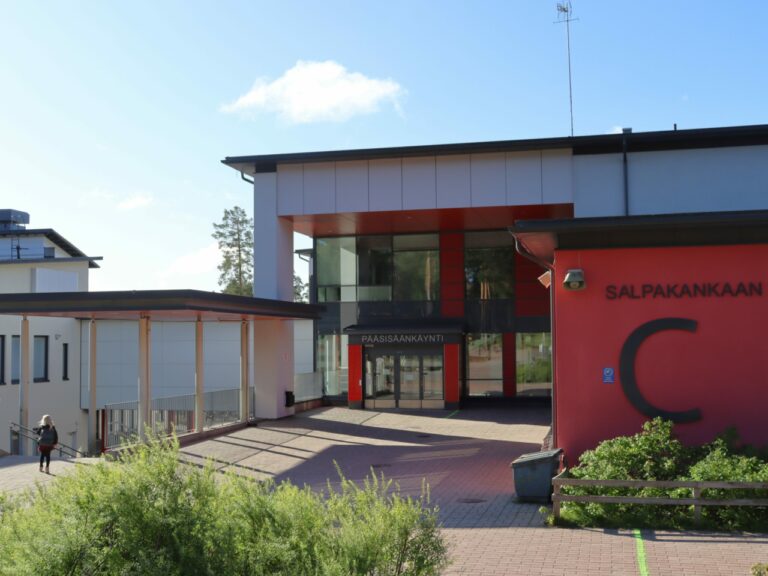
Preparatory education in Hollola is organized at the Salpakangas school.
Completion of compulsory schooling in home education
Education is compulsory in Finland. This means that a person of compulsory school age must participate in basic education organized by the municipality of residence or obtain information corresponding to the curriculum of basic education in another way. If you wish, you as a guardian can take responsibility for your child's compulsory education. In this case, your child's teaching and learning support will be transferred to you. You can read more about the homeschooling process in the municipality of Hollola in the PDF file below.
It is important to be aware that certain flexibilities in the organization of studies enabled by regulations only apply to those attending school. In home education, for example, it is not possible to exempt a subject from the basic education curriculum. Courses cannot be individualized either. As a guardian, you are therefore responsible for ensuring that your homeschooled child studies in all subjects with the content and goals of Hollola's pre-primary and basic education curriculum in accordance with general education.
If, as a guardian, you want your child to receive a certificate equivalent to a basic education certificate, the child must also participate in a special degree. In the degree, the teacher examining the degree, together with the necessary other teaching professionals, evaluates the level of competence in relation to the goals defined in the curriculum. Those who have successfully completed a special degree will be given a certificate of completion of the basic education curriculum in whole or in part.
The municipality of residence is responsible for monitoring the progress of compulsory education. A supervising teacher appointed by the municipality will assess, based on evidence and materials, that your child is studying in accordance with the goals and content recorded in the jointly agreed plan. At the end of the school year, the supervising teacher will prepare a written report on the progress of compulsory education.